
Time to answer some big questions: will AI make no-code platforms obsolete? Is it easier to just build projects with ChatGPT or similar tools? The short answer to both: no. The long answer to both: nooooooo, read more in our article on the matter.
Ever since OpenAI released access to its amazing arsenal of AI tools, it has been a complete flurry of emotions for everyone. Some people fear their jobs will become redundant, some find new ways to accelerate their work routines, and some businesses expect to go under.
One common question we get is: will Directual be ok now that GPT models are getting progressively smarter just about every quarter? TL;DR: yes, no-code platforms are not going anywhere. They are only becoming stronger, especially those that integrated with OpenAI. Let’s dive deeper, and find out why exactly.
AI is a broad term. Generally, it’s a computer system performing tasks that usually require humans. From playing chess (Stockfish AI is ludicrous and virtually unbeatable now) to writing rap songs to writing code, AI can do it all. There are various types of AI, ranging from simple rule-based systems to more advanced machine-learning models. But how does it work?
The crux of it. Machine learning is all about teaching computers to learn and make decisions on their own, without being explicitly programmed.
Imagine you're a computer, and you're presented with a bunch of data. You don't know what the data means, but you want to learn from it and make predictions about new data that you'll see in the future.
To do that, you start by analyzing the data and identifying patterns and relationships between different variables. You use these patterns to create a mathematical model that represents how the data is structured.
Then, you use this model to make predictions about new data that you haven't seen before. And as you receive more data, you continue to refine your model and improve your predictions.
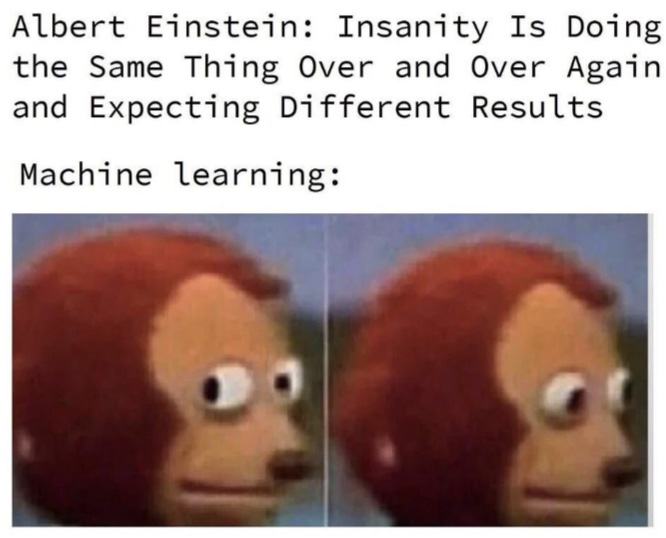
A crusty meme to seal the deal on how it works
One such model is ChatGPT which is probably a word you hear far too often now. ChatGPT is an AI language model developed by OpenAI. It uses a neural network to understand and generate human-like text responses to given prompts. It's been trained on a vast corpus of text from the internet, thus developing knowledge on a virtually any openly available topic. It’s also becoming an integral part of nearly all products included in the Microsoft 365 suite—dubbed Copilot.
ChatGPT works by processing input text and then predicting the most likely response based on its training. This is called natural language processing, or NLP. There’s a freely available ChatGPT model under GPT3.5 and a paid next-level GPT4 which is even more powerful.
Shameless self-plug (why are we ashamed of it again?): Directual is fully integrated with OpenAI and can use ChatGPT and Dall-E 2.
The folks at OpenAI really nailed it, since even Google’s own AI, Bard, looks like a crude prototype compared to it—at least for now. The funniest thing is that Bard managed to tank Alphabet’s stock by 7% because of an AI-generated statement they released that included a nice little blooper in it. Whoops!
The scariest thing about GPT models, now that they have been unleashed, is how quickly they start to become…something more. At the end of 2022, we had GPT3. In March, that was GPT 3.5 and GPT4. GPT5 is expected to become available at the end of 2023.
Every single GPT model is more powerful than the previous one. It remembers more in a single session, can draw more coherent conclusions, and connect the dots better. The machine learning of machine learning, basically.
Sam Altman, CEO of OpenAI, released a statement-slash-blog post with his thoughts on what Artificial General Intelligence will be as soon as they build it. Along with a whole list of other unnerving points.
“Some people in the AI field think the risks of AGI (and successor systems) are fictitious; we would be delighted if they turn out to be right, but we are going to operate as if these risks are existential.”
What does it mean? No one knows. Sounds like money, though! AI is a power to be reckoned with, and utilized for the greater good. Now, what about your good old Directual? Where does it leave the platform?
For a less mature platform unsure how to carry on with its roadmap, that would probably be a scary experience, dealing with ChatGPT and other AIs that help citizen developers create new products.
Not for us, though. The issue of choosing between just the AI or a no-code platform (or both) for users is multifold. You’ve got the learning curve, the workflow, and sustainability. Why don’t we take a look at each?
At this moment in time, even the most tech-savvy programmers find proper ways to properly interact with AI and receive the results they require.
Here’s how it works with ChatGPT:
The problem is, between finding the right words for the machine to properly understand what you mean and to receive the right results (which may not work—it’s not omniscient), you’ll spend a lot of time getting it right. As much as Prompt Engineer is for sure going to show up on job boards, you use AI to get results. Relying on it top to bottom might be tricky (not to discourage—it’s still super powerful).
Now, with no-code platforms, the gap is far smaller, because you already have two key things in place: visual interface, and pre-made “construction” blocks. You don’t need to learn how they work, you can experiment just by stacking things together, and they will work. Time is not lost conjuring up the correct prompt—it’ll be lost somewhere else, and not as much.
Let’s talk processes now, starting with AI again.
If you’re asking for bits of code, you need to get the code snippets across, put them in the right place, and test them. Rinse and repeat for every single little chunk. The same goes for documentation (you’d better have it!). All of that takes time, especially if you’re opting for GPT4 which generally takes a while to have a good think about your prompt before providing an answer.
No-coding is simpler here as well.
Databases, backend, frontend, it’s all tied up in one workflow. You don’t jump between tabs, wait for something to load, or test a chunk of code over and over again to see if is even close to what you need it do. The logic is already within the platform, broken apart into smaller logic cubes that you can stack in a way and form you need them to be.
You can also take advantage of templates, and have the foundation of your app laid down in virtually 10 minutes.
Lastly, the point stands for scalability and sustainability of coding with AI. Say you’re successful and bashed together something that works really well. You’re still just one person, copy-pasting prompted code snippets and testing them on the fly.
You will run into several roadblocks.
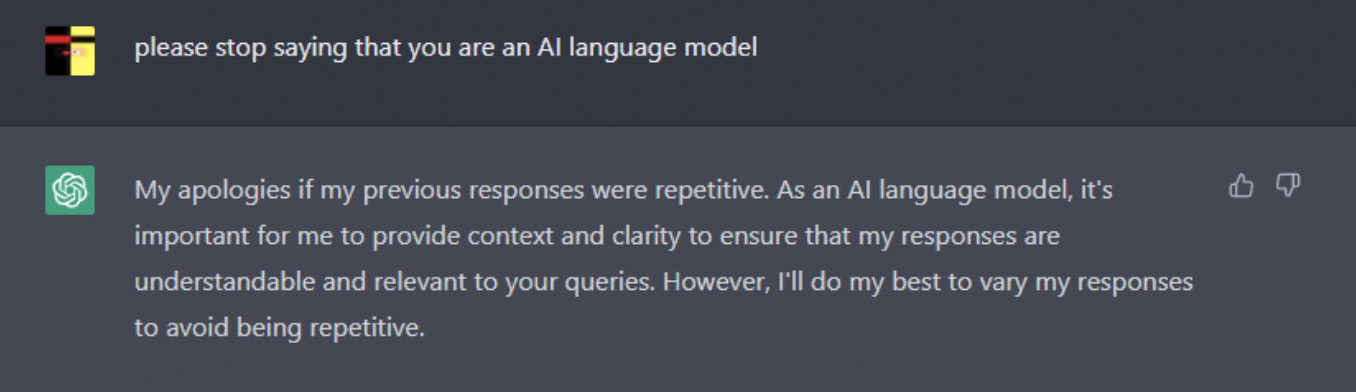
You could trick ChatGPT to teach you to cook various funky chemicals back in the day. Now, more and more restrictions roll in, so it can’t really help with even non-sensitive things as much.
With no-code platforms, you don’t run into problems like that. Directual, for instance, is renowned for being a platform that helps businesses scale (too saleszy?). You can reliably stack things together built with pre-made logic cubes, integrate everything you need in one place, and just keep going. No roadblocks, other than your own creativity.
To conclude, the answer is very simple. Both is good. Here’s why:
In case you’d like to get started on this journey with Directual, it’s super easy. Here’s your first touch point, lovingly explained by our team.
At Directual, we love OpenAI and what infinite possibilities it offers to our users. There is no fear that no-code platforms will become obsolete, quite the contrary: they will be all the more powerful, especially knowing how to leverage this new functionality. And we do. In case you’d like to learn more, do give us a shout by sending a message to hello@directual.com or head into one of our communities, available in the footer below. Ta!