Features


Solutions
Who uses Directual and why?


What can be built on the platform?



What industries benefit from Directual?

Learn


We had Claude Code and Codex build the same shop backend 18 times and tried to break it. The code held. Then we asked five questions a shop owner gets at night. An agent answers them in under a minute for $0.30. A person without an agent needs SQL and the worker code, and two of the five questions have no answer at all, for anyone.
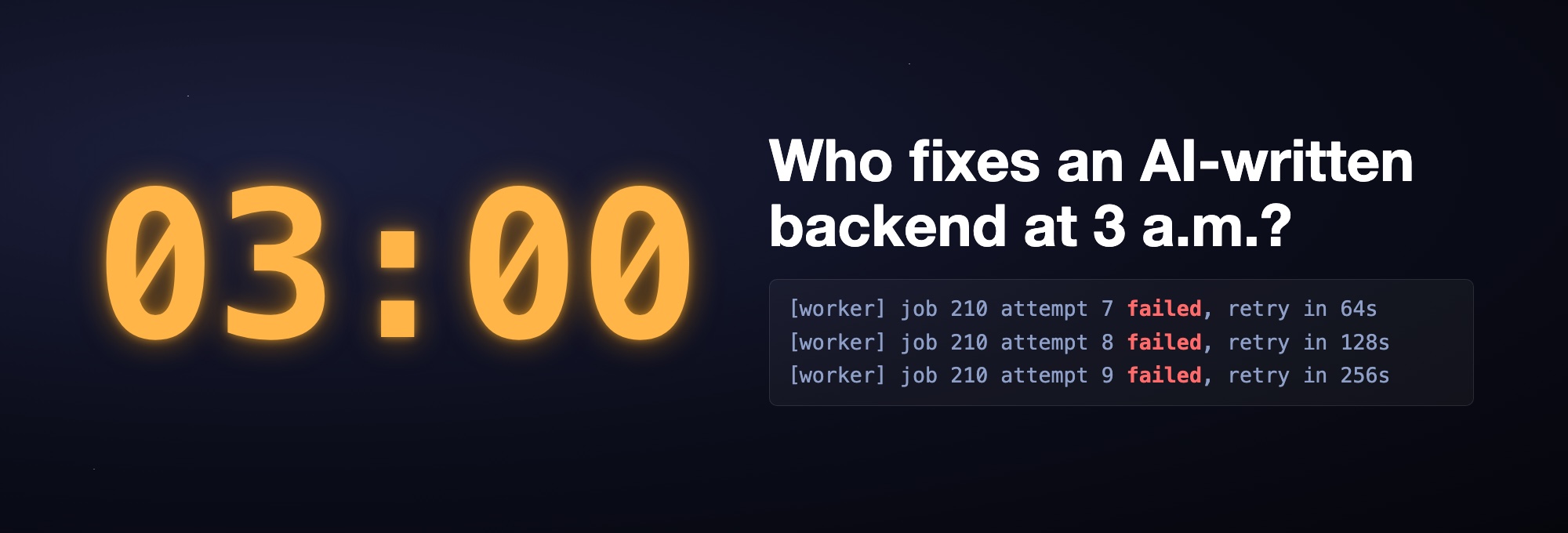
We had two coding agents build the same small shop backend 18 times, then threw production failures at it. The code held: duplicate webhooks, a dying warehouse API, a kill -9 mid-request, 30 buyers racing for the last 5 bags of coffee. That is not where AI-written backends break.
They break at 3 a.m., when the owner gets a message from a customer and has to find out what happened in code no person has ever read. We tested that too. Short version: with an agent, five night questions take under a minute and 30 cents. Without one, they take SQL, JSON operators and the worker code. And two of the five have no answer at all, for anyone, because nobody asked the agent to build the thing that would answer them.
The task was an orders API for a coffee shop: customers, products with stock, orders, a signed payment webhook, a receipt email and a shipment to an external warehouse. Claude Code (Claude Opus 5.5) and Codex (gpt-6.1-sol) each built it nine times, alone, from an empty folder. We ran three series: production conditions spelled out in the spec; no conditions, only the API docs; and no conditions with a bare sandbox that hinted at nothing.
Then we ran 14 probes against every build, and a second agent session added a required field against a database we told it was production.
| What we threw at it | Builds that survived |
|---|---|
| Customer B reads, lists and cancels customer A's order | 18 of 18 |
| Unsigned or wrongly signed payment webhook | 18 of 18 |
| The same webhook twice, and five copies at once | 18 of 18 |
| The warehouse drops the connection, then answers 503 | 18 of 18 |
| 30 buyers, 5 bags in stock | 18 of 18 |
kill -9 while the warehouse call is in flight, then restart: exactly one shipment, one receipt |
18 of 18 |
| A new required field added on live data: no lost orders, old passwords still work | 18 of 18 |
| The warehouse always takes 12 seconds to answer | 9 of 18 |
Every build, unprompted, used the same design a senior engineer would: a job queue in Postgres with leases and SKIP LOCKED, an idempotency key on every outbound call, conditional stock updates, a constant-time signature check, a non-destructive migration. Builds took 4 to 15 minutes. A Claude run, build plus change, cost $1.60 to $2.20.
The one failure is instructive. Agents pick a sensible default timeout of 5 or 10 seconds. A warehouse that answers in 12 never gets through. The order stays "paid" forever while the system retries in the background. One agent's code gives up after 20 attempts and writes a line to the log. Another retries indefinitely and says nothing.
So the code is fine. What is missing is a reader.
The service we used for the night test is 832 lines of Node.js, written in five minutes. It even comes with a good README. Nobody has read it: not the author, who is a model; not a reviewer, because there was none. The owner becomes its first human reader at the worst possible moment.
It does not get better over time. The next feature is written by an agent too, and the one after that. The code grows; the number of people who have read it stays at zero. Every time something has to be understood, the owner calls an agent, and the agent reads everything again from scratch.
We kept the service running for three days of synthetic shop life: 40 customers, 125 orders, one price changed quietly in the database. Then the warehouse started answering slower than the service's timeout. The owner has the code, the settings file, the log, the database and five questions:
We gave the same questions to fresh Claude Code and Codex sessions with no context, read-only. Then we traced, step by step, what a person without an agent has to do to answer each one. We did not put a person through it this time, so the right-hand column is our breakdown, not a stopwatch.
| Question | Agent, fresh session | What a person needs without an agent |
|---|---|---|
| 1. Where is the order? | Both correct: paid, receipt sent, every shipment attempt times out after 10 s | A SQL join from the customer's email to her orders, then to a jobs table through a JSON field. The log says "job 210 attempt 8 failed" and never mentions the order or the time |
| 2. Still trying? | Both correct: attempt 8 of 20, delays doubling up to 10 minutes, then dead, then nothing |
The jobs table for the count; the worker code or the README for the retry rules |
| 3. Pause shipments | Both correct: there is no switch. A SQL workaround delays queued jobs, but every new payment schedules a new one | Understanding the worker loop well enough to see that the switch does not exist |
| 4. Rotate the secret | Both correct: an environment variable read at start; change it at the provider and in the settings, restart, expect 401s in between | Knowing where the settings live, how to restart without a stop script, and that the provider will retry |
| 5. Who changed the price? | Both correct: nobody can tell. Claude narrowed "when" to a 10-hour window from order amounts | The same answer, after realising there is no audit anywhere |
The agents were good. Claude Code answered all five in 57 seconds for $0.29; Codex in 47 seconds. Claude even noticed that our synthetic history did not add up: eight attempts with that backoff should take five minutes, not two hours.
Three things stand out.
The log speaks a different language from the customer. The customer has an email and "two hours ago". The log has job numbers and no timestamps. The bridge is a JSON field in a table the owner did not know existed.
The agent reads everything, every time. Both sessions read essentially the whole codebase before answering. At 832 lines that costs 30 cents. The service will not stay at 832 lines, and the next incident starts from zero again.
Two questions have no answer, for anyone. There is no switch to pause shipments, and no record of who changed a price. Not a bug: nobody asked for them. The agent built exactly the service in the spec, and the spec did not say "the owner will need to see and steer this at night". Neither would yours.
And one thing nobody saw. In our setup, as with many real APIs, the warehouse created the shipment on the very first request; the service just never got the answer back. The coffee is probably on its way. The system says it is not, and neither agent mentioned it.
None of this is solved by better code. It is solved by things the owner can see and touch without reading code:
Ask your agent to build these and it will: it built everything else we asked for. But each one is another few hundred lines nobody reads, and they are the same few hundred lines for every backend. They belong to the platform the backend runs on, not to each app.
kill -9 probe with two shipments.