Two mindsets are clashing: the fast-flowing vibe-coding, where AI drives creativity, and the structured low-coding, where control and architecture matter. This article explores how to balance the two.
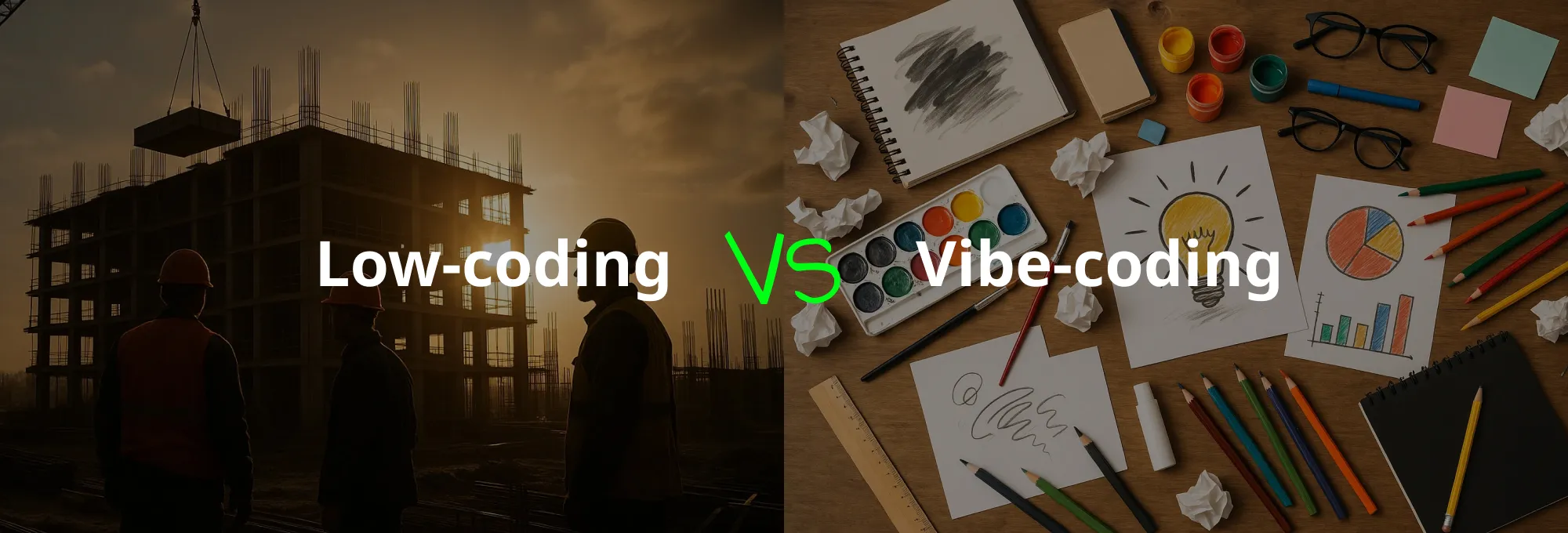
The new wave of software development is driven by AI — not just as a helper, but as a co-creator. More and more apps are built through AI-generated code rather than by human engineers. It’s fast and inspiring, but it also introduces new risks: fragile architecture, security gaps, and deep dependency on external services.
Vibe-coding is a new development philosophy. Instead of building systems — you flow. Instead of configuring APIs — you generate them. Instead of spending a week coding — you build it in one evening with an AI copilot.
The idea is to remove friction and make software creation feel intuitive. The AI suggests, completes, and corrects — and the result appears almost instantly.
But there’s a catch: when architecture emerges spontaneously, control over the system fades. The app might work — but why it works that way isn’t always clear, even to its author.
Lovable has become one of the poster children of vibe-coding. It’s tightly integrated with Supabase, a powerful backend platform built on PostgreSQL. The combo allows creators to launch projects incredibly fast — sometimes within a day.
But where everything is generated automatically, it’s hard to maintain architectural integrity. Common issues include:
That said, Lovable serves its purpose perfectly — as a rapid prototyping tool. For demos, proof-of-concepts, and creative experiments, it’s a great match.
If vibe-coding is about speed, low-coding is about stability. Platforms like Directual focus on combining visual speed with full control over architecture, logic, and scalability.
Low-code development allows you to design visually without losing clarity.
It’s less “magical” than vibe-coding — but much more predictable and resilient.
Feature
Vibe-coding (Lovable + Supabase)
Low-coding (Directual)
Approach
Generation and flow
Architecture and control
Startup speed
Maximum
High but intentional
Security
Depends on Supabase configuration
Built-in, role-based API control
Scalability
Limited by Supabase schema
Flexible and predictable
Use case
Prototypes, MVPs, idea testing
Full-scale products, business systems
Vibe-coding and low-coding aren’t rivals — they’re different stages of product evolution.
You start with flow and inspiration, but as your product grows — architecture, logic, and safety become essential.
Low-code platforms bring structure to that chaos, keeping what’s great about no-code freedom while adding the discipline of software engineering.
💡 The balance is simple: vibe-coding fuels creativity, low-coding builds sustainability. One helps you start — the other keeps you alive.
🔜 Spoiler: soon, we’ll unveil a major update that blends the best of both worlds — the creative flow of vibe-coding with the precision and security of low-code. A new assistant is coming to help you build intuitively, without sacrificing architecture or control.